Showing posts with label English translations. Show all posts

Monday, August 29, 2011

Intermezzo Sunday Concert, 10/9/2011 @ 2:30 p.m.


Shawn I. Puller, tenor
Read Gainsford, piano


Faculty artists from Albany State University and Florida State University team up for an afternoon of song!
PROGRAM SELECTIONS

Roger Quilter
     5 Shakespeare Songs (Second Set), Op. 23
Fear no more the heat o' the sun
Under the greenwood tree
It was a lover and his lass
Take, o take those lips away
Hey, Ho, the wind, and the rain

Wolfgang Amadeus Mozart
Dalla sua pace (from Don Giovanni)

Vincenzo Bellini
Il fervido desiderio
Dolente immagine di Fille mia

Franz Liszt
Du bist wie eine Blume
Im Rhein im schönen Strome
Hohe Liebe

Sergei Rachmaninoff
Lilacs (Op. 21, No. 5)
A Dream (Op. 8, No. 5)
Here All is Just Right (Op. 21, No. 7)

Juan Bautista Plaza
     from Siete canciones venezolanas
Por estos cuatro caminos
Hilando el copo del viento
Cuando el caballo se para

John W. Work III
          Soliloquy

Richard Pearson Thomas
          I Never Saw a Moor

Undine S. Moore
          Love let the wind cry...How I adore thee!


Tenor Shawn Puller (Ph.D) is an Assistant Professor of Music at Georgia's Albany State University, and has taught in New York at SUNY Cortland and Ithaca College, as well as at Florida State University, where he is on the faculty of their Summer Music Camps. As director of both bands and choruses his teaching experience includes instruction of children as well as young adults, and as a vocal soloist, in addition to art-song literature, his repertoire includes opera, oratorio, and other large-scale choral works. Shawn has directed the music programs of several churches, and also has served as the Assistant Director of the Heifetz International Music Institute, in Wolfeboro, New Hampshire. Among other professional organizations, Dr. Puller is an active member of the National Association of Teachers of Singing, and serves as the head Archivist of the Georgia Chapter of NATS.


Pianist Read Gainsford (D.M.) has performed widely in the USA, Europe, Australia, South Africa, and his native New Zealand as solo recitalist, concerto soloist and chamber musician. He has made successful solo debuts at the Wigmore Hall and Carnegie Hall's Weill Recital Hall, and has performed in many other prestigious venues, including the Kennedy Center, Queen Elizabeth Hall, Barbican Centre, Fairfield Halls, Birmingham Town Hall and St.-Martin-in-the-Fields. Dr. Gainsford has recorded for the Amoris label, BBC Radio Three, Radio New Zealand's Concert Programme, and has broadcast on national television in New Zealand, the UK, and Yugoslavia. Since moving to the United States in 1992, Read has been a guest artist for the American Music Teachers Association, has appeared at the Gilmore Keyboard Festival and the Music Festival of the Hamptons, and spent several summers as a member of the collaborative pianist faculty at the Heifetz International Music Institute. He is a member of the contemporary music group Ensemble X, the Garth Newel Chamber Players, and, in addition to providing our opener with Dr. Puller in 2010, he has performed on Music @ Main programs twice as the pianist with FSU's Trio Solis. Formerly on the faculty of Ithaca College where he received the college-wide Excellence in Teaching Award in 2004, Dr. Gainsford became Associate Professor of Piano at FSU in 2005.

PROGRAM NOTES, by Ed Lein, Music Librarian


Although some of the lighter orchestral pieces by Roger Quilter (1877-1953) are still performed, outside his native Great Britain Quilter's reputation is sustained primarily through his art songs, which number more than a hundred. Quilter began his studies at Eton College, and in the 1890s he continued his musical education in Germany. In addition to Quilter, there were several other English-speaking composers who studied at the Hoch Conservatory in Frankfurt (although not all at the exact same time), including Percy Grainger and Cyril Scott, and together they became known as the "Frankfurt Group." In 1900, Quilter published his first songs, and following performances the next year he quickly became established as a composer with a special gift for creating melodies that enhanced the natural rhythm of the words, while also providing fully-realized accompaniments that nonetheless allowed the singer to make expressive use of rubato. As an interpreter of his own songs, Quilter sometimes provided the piano accompaniment for public performances, and he even recorded several of them.
In 1905, Quilter's Three Shakespeare Songs, Op. 6, provided an early success, but he waited until 1919 to return to The Bard for inspiration, composing a song (Under the Greenwood Tree) and a duet (It was a Lover and His Lass) on lighthearted texts from As You Like It. In 1921, Quilter included these as the second and third selections in his Five Shakespeare Songs, Op. 21, recasting the duet as a solo. The text for the elegiac first song, Fear No More the Heat o' the Sun, is from Cymbeline. The beautiful and concise 4th song, Take, O Take Those Lips Away, which is from Measure for Measure, was later adapted for piano quartet by the composer. The cycle ends with Hey, Ho, the Wind and the Rain, the song which likewise provides the conclusion for its source, Twelfth Night.
Hear them on YouTube
Complete Score (pdf), from imslp.org.
Fear No More the Heat o' the Sun
Fear no more the heat o' the sun,
     Nor the furious winter's rages;
Thou thy worldly task hast done,
     Home art done, and ta'en thy wages:
Golden lads and girls all must,
As chimney-sweepers, come to dust.

Fear no more the frown o' the great;
     Thou art past the tyrant's stroke;
Care no more to clothe and eat;
     To thee the reed is as the oak:
The Sceptre, Learning, Physic, must
All follow this, and come to dust.

Fear no more the lightning-flash,
Nor the'all-dreaded thunder-stone;
Fear not slander, censure rash;
Thou hast finished joy and moan:
All lovers young, all lovers must
Consign to thee, and come to dust.
No exorciser harm thee!
Nor no witchcraft charm thee!
Ghost unlaid forbear thee!
Nothing ill come near thee!
Quiet consummation have,
And renownèd by thy grave!
Under the Greenwood Tree

UNDER the greenwood tree,
Who loves to lie with me,
And turn his merry note
Unto the sweet bird's throat,
Come hither, come hither, come hither:
     Here shall he see
     No enemy
But winter and rough weather.

     Who doth ambition shun,
     And loves to live i' the sun,
     Seeking the food he eats,
     And pleased with what he gets,
Come hither, come hither, come hither:
     Here shall he see
     No enemy
But winter and rough weather.
It was a Lover and his Lass

IT was a lover and his lass,
     With a hey, and a ho, and a hey nonino,
That o'er the green corn-field did pass,
     In the spring time, the only pretty ring time,
When birds do sing, hey ding a ding, ding;
Sweet lovers love the spring.

Between the acres of the rye,
     With a hey, and a ho, and a hey nonino,
These pretty country folks would lie,
     In the spring time, the only pretty ring time,
When birds do sing, hey ding a ding, ding;
Sweet lovers love the spring.

This carol they began that hour,
     With a hey, and a ho, and a hey nonino,
How that life was but a flower
     In the spring time, the only pretty ring time,
When birds do sing, hey ding a ding, ding;
Sweet lovers love the spring.

And, therefore, take the present time
     With a hey, and a ho, and a hey nonino,
For love is crownèd with the prime
In the spring time, the only pretty ring time,
When birds do sing, hey ding a ding, ding;
Sweet lovers love the spring.
Take, Oh Take Those Lips Away
Take, oh take those lips away,
     That so sweetly were forsworne,
And those eyes: the breake of day,
     Lights that doe mislead the Morne;
But my kisses bring againe, bring againe,
Seales of love, but seal’d in vaine, seal’d in vaine.
Hey, ho, the Wind and the Rain
     [NOTE: Quilter omits Shakespeare's original 4th verse, also omitted here]

When that I was and a little tiny boy,
     With hey, ho, the wind and the rain,
A foolish thing was but a toy,
     For the rain it raineth every day.

But when I came to man’s estate,
     With hey, ho, the wind and the rain,
‘Gainst knaves and thieves men shut the gate,
     For the rain it raineth every day.

But when I came, alas! to wive,
     With hey, ho, the wind and the rain,
By swaggering could I never thrive,
     For the rain it raineth every day.

A great while ago the world begun,
     With hey, ho, the wind and the rain,
But that’s all one, our play is done,
     And we’ll strive to please you every day.


Austrian-born Wolfgang Amadeus Mozart (1756–1791), unquestionably one of the greatest composers in history, began his career touring Europe as a 6-year-old piano prodigy, and he absorbed and mastered all the contemporary musical trends he was exposed to along the way.
Of all the different versions of the Don Juan legend, Mozart’s comic opera, Don Giovanni (1787), on a libretto by Lorenzo da Ponte (1749-1838), is among the best known and most discussed. The Don is an unrepentant rake who lives solely for his own selfish pleasures, with utter disregard for how his behavior might affect others. Mozart’s opera picks up as Giovanni’s luck finally begins to fade and his past begins to catch up with him. He is on the run after dueling with and killing the father of Donna Anna, a would-be romantic conquest. Anna asks Don Ottavio, her fiancé, to avenge her father's death, and when left alone Ottavio sings Dalla sua pace, reflecting, basically, that her wish is his command.

Hear it on YouTube
Dalla sua pace

Dalla sua pace la mia dipende;
Quel che a lei piace vita mi rende,
Quel che le incresce morte mi dà.

S'ella sospira, sospiro anch'io;
È mia quell'ira, quel pianto è mio;
E non ho bene, s'ella non l'ha.

--Don Octavio's Act I aria from Don Giovanni
Libretto by Lorenzo da Ponte
On Her Mind's Peace


Along with the operas of Rossini and Donizetti, those of Italian composer Vincenzo Bellini (1801-1835) have come to epitomize the essence of the lyrical vocal style we now call bel canto (i.e., "beautiful singing"), as opposed to the more forceful and declamatory style represented by Wagner. Bellini, whose operas include Norma (1831), La sonnambula(1831), and I Puritani (1835), was born into a musical family, and he showed prodigious talent from an early age. Little Vinnie reportedly was singing arias before he was two, and before he turned three he had begun to study music theory (remember, kryptonite didn't make an appearance until the 20th Century ...). At age 18, Bellini entered the conservatory in Naples, where, for his graduation in 1825, his first opera was produced; and by the fall of 1827 Il pirata (The Pirate) premiered at La Scala in Milan. Before too long, Bellini went from being local sensation to international celebrity, and elements of his style--sensuous, long-flowing melodies and sometimes surprising harmonic shifts--are said to have had a great impact on the young Frédéric Chopin (1810-1849). Bellini's rise was cut short at the height of his popularity, when he grew ill in Paris (on an extended stopover between London and Milan), and died from acute intestinal and liver maladies.
During the first few years after he left the conservatory Bellini composed more than a dozen songs with piano. Among these, Il fervido desiderio and Dolente immagine di Fille mia were published posthumously, along with a third song, as Tre ariette; the authorship of the texts is unknown.
Score for Il fervido desiderio (pdf), from imslp.org
Hear it on MySpace
Il fervido desiderio

Quando verrà quel dì
che riveder potrò
quel che l'amante cor tanto desia?

Quando verrà quel dì
che in sen t'accoglierò,
bella fiamma d'amor, anima mia?
The Fervent Desire

Score for Dolente immagine di Fille mia (pdf), from imslp.org
Hear it on YouTube
Dolente immagine di Fille mia

Dolente immagine di Fille mia,
perché sì squallida mi siedi accanto?
Che più desideri? Dirotto pianto
io sul tuo cenere versai finor.

Temi che immemore de' sacri giuri
io possa accendermi ad altra face?
Ombra di Fillide, riposa in pace;
è inestinguibile l'antico ardor.
Mournful Image of Phyllis Mine


Hungarian- composer Franz Liszt (1811-1886) is widely regarded as the greatest pianist of all time, and his performances excited an hysteria that today is reserved for only the most popular of rock stars. Despite great fame following a sometimes impoverished youth, Liszt remained unspoiled and donated great sums of his concert earnings to a wide variety of charitable causes, and in later life he even took orders in the church. His generosity extended to helping increase the fortunes of struggling musicians, among them Hector Berlioz and Liszt’s future son-in-law, Richard Wagner. An innovative composer, Liszt is credited with creating the symphonic tone poem as a form, developing the technique of thematic transformation, and he even anticipated some of the harmonic devices of Impressionist composers.
Heine's poem, Du bist wie eine blume, has been set by dozens of different composers (including a Russian version by Rachmaninoff), and, along with Robert Schumann's setting, Liszt's is among the most famous. This year marks the 200th anniversary of Liszt's birth, and, fortunately for him, good penmanship is not a criterion for immortality, as the autograph manuscript of the song (1843?) attests. A solo piano version of the song was prepared by Joachim Raff (1822-1882--Raff would become Liszt's music copyist for a time ...), which Liszt performed. Liszt himself prepared a concert arrangement for solo piano of Im Rhein, im schönen Strome (1840?/1854), as well as of Hohe Liebe (1850), which became the first of Liszt's three Liebesträume (Dreams of Love).

Du bist wie eine Blume

Du bist wie eine Blume
so hold und schön und rein;
ich schau' dich an, und Wehmut
schleicht mir ins Herz hinein.

Mir ist, als ob ich die Hände
aufs Haupt dir legen sollt',
betend, daß dich Gott erhalte
so rein und schön und hold.

--Text: Heinrich Heine (1797-1856)

Thou Like a Budding Flower Art

Hear it on YouTube Score from imslp.org (pdf)

Im Rhein

Im Rhein, im schönen Strome,
Da spiegelt sich in den Wellen
Mit seinem großen Dome
Das große, das heil'ge Köln.

Im Dom da steht ein Bildnis,
Auf goldnem Leder gemalt;
Ach, In meines Lebens Wildnis
Hat's freundlich hinein gestrahlt.

Es schweben Blumen und Englein
Um unsre liebe Frau;
Die Augen, die Lippen, die Wängelein,
Die gleichen der Liebsten genau.

--Text: Heinrich Heine (1797-1856), altered slightly

In the Rhine

Hear it on YouTube Score (2nd version) from imlsp.org (pdf)
Score (1st version) from imlsp.org (pdf)

Hohe Liebe

In Liebesarmen ruht ihr trunken,
Des Lebens Früchte winken euch;
Ein Blick nur ist auf mich gesunken,
Doch bin ich vor euch allen reich.

Das Glück der Erde miss' ich gerne
Und blick, ein Märtyrer, hinan,
Denn über mir in goldner Ferne
Hat sich der Himmel aufgetan.

--Text: Johann Ludwig Uhland (1787-1862)

Exalted Love

Hear it on YouTube Score from imslp.org (pdf)


Sergei Rachmaninoff (1873-1943) was a  Russian composer and conductor, and one of the greatest pianists of all time. Although of the 20th Century, Rachmaninoff's music remained firmly rooted in 19th-Century Russian Romanticism. For a time some post-World War II critics foolishly dismissed him as old-fashioned, but the lush harmonies and sweeping melodies that characterize his music assure it a continuing place in the world’s concert halls. Astonishingly, Rachmaninoff had what might be called a "phonographic" memory in that upon hearing virtually any piece he could play it back at the piano, even years later—and if he liked the piece it would sound like a polished performance!

Rachmaninoff composed songs throughout his career, and his choral music has a devoted following among aficionados.  His melodic talent was perfectly suited to vocal music so it is surprising that his songs are not better known. Rachmaninoff completed his six Romances, Op. 8, in 1893, and the 12 Romances, Op. 21, in 1902, and he adapted both Lilacs and Here All is Just Right (often translated as "How fair this spot") as pieces for piano solo.


Сирень (Op. 21, No. 5)

По утру, на заре,
По росистой траве,
Я пойду свежим утром дышать;
И в душистую тень,
Где теснится сирень,
Я пойду свое счастье искать...

В жизни счастье одно
Мне найти суждено,
И то счастье в сирени живёт;
На зелёных ветвях,
На душистых кистях
Моё бедное счастье цветёт...

--Text: Ekaterina Andreyena Beketova (1855-1892)
Hear it on YouTube

Lilacs

Complete score (pdf), from imlsp.org


Сон (Op. 8, No. 5)

И у меня был край родной;
    Прекрасен он!
Там ель качалась надо мной...
    Но то был сон!

Семья друзей жива была.
    Со всех сторон
Звучали мне любви слова...
    Но то был сон!

--Text: Aleksey Nikolayevich Pleshcheyev
(1825-1893, after Heine)


A Dream

Complete score (pdf), from imlsp.org

Здесь хорошо (Op. 21, No. 7)

Здесь хорошо...
Взгляни, вдали
Огнём горит река;
Цветным ковром луга легли,
Белеют облака.

Здесь нет людей...
Здесь тишина...
Здесь только Бог да я.
Цветы, да старая сосна,
Да ты, мечта моя!

--Text: Glafira Adol'fovna Galina (1873-1942)

Hear it on YouTube
Hear it again on YouTube


Here All is Just Right

Complete score (pdf), from imlsp.org


At the tender age of 16 years, Venezuelan composer, educator and ethnomusicologist Juan Bautista Plaza (1898-1965) was appointed choirmaster at his school in Caracas, and he continued in that post even after he entered University, ostensibly to study law and medicine. But music won out, and in 1920 he was sent on scholarship to Rome, Italy, becoming a Master of Sacred Composition (1923). He returned to Caracas as the choirmaster of the cathedral (1923-1947), and was also a professor at the Escuela Nacional de Musica (1924-28/1936-62). In 1936, Plaza began studying and cataloging a large collection of Venezuelan colonial music, eventually published in 12 volumes in 1943, making him a central figure in the growth of Venezuelan Nationalism. He was a prolific writer and lecturer, and produced daily newspaper articles and hundreds of radio talks for the general public.

Plaza's Siete canciones venezolanas (Seven Venezuelan Songs) (1932) are on Spanish texts by Venezuelan poet Luís Barrios Cruz (1898-1968). The songs are an example of Plaza's brand of música criolla, drawing on popular Venezuelan songs and dances of partially European origin, and they may well have been inspired by Siete canciones populares españolas (1914), by Spanish composer Manuel de Falla (1876-1946).

The three mp3s from /www.fundacionjuanbautistaplaza.com

Por estos cuatro caminos (Over These Four Roads)
CLICK HERE for the original Spanish text (still under copyright) and an excerpt from the score.
No 5. Por estos cuatro caminos (MP3)

Hilando el copo del viento (Spinning the Puff of Wind)
No 4. Hilando el copo del viento (Excerpt--MP3)
Cuando el caballo se para (When the Horse Stops)
No 3. Cuando el caballo se para (Excerpt--MP3)


Both John Wesley Work III (1901-1967) and his brother, Julian, became the third generation of professional musicians in their family: their grandfather, the first John Wesley Work, was a Tennessee church musician and choral arranger; their father, John Wesley Work II, was a singer, ethnomusicologist and professor at Fisk University, in Nashville; and their mother, Agnes Haynes Work, was a singer and choral director at Fisk. In addition to composing, John W. Work III followed extremely closely in both his parent's footsteps, becoming an important ethnomusicologist, as well as both choral director and professor of music theory and composition at Fisk, eventually becoming chair of the music department there in 1950. He began composing as a high school student, and throughout his career wrote over 100 works in a variety of genres, with songs and choral music dominating his output. In 1946 he won first prize from the Federation of American Composers' competition for a cantata, The Singers, and the following year he received an award from the National Association of Negro Musicians. Also dating from 1946, Soliloquy is a setting of a text by Myrtle Vorst Sheppard--still under copyright, so it cannot be reprinted in its entirety, but the beginning and ending lines aptly convey the sentiment of the whole song:
If death be only half as sweet as life, I will not fear, I'll shed no tear,
Nor will I ask my friends to weep;
...
If death be only half as sweet as life, I will not fear to go.
I love life so! I love life so!
Hear it on YouTube

The versatile New York pianist and composer Richard Pearson Thomas (b. 1957) is at home in both the musical theater and the concert hall. In addition to accompanying recitals with singers at major U.S. and international venues, he composes for films and the stage, including the Off-Off-Broadway shows Parallel Lines (2005) and Ladies in a Maze (1996). The Montana native is a graduate of the Eastman School of Music and the University of Southern California, was on faculty at Yale and the University of Central Florida, and currently is on the faculty at Teachers College/Columbia University. He has composed more than 80 operas with students in New York City public schools as composer-in-residence of the Gold Opera Project, Young Audiences/New York.
I Never Saw a Moor (1991) is a setting of a poem by Emily Dickenson (1830-1886).

Hear it on the Composer's website
I never saw a moor,
I never saw the sea;
Yet know I how the heather looks,
And what a wave must be.

I never spoke with God,
Nor visited in heaven;
Yet certain am I of the spot
As if the chart were given.


Sometimes called "Dean of Black Women Composers," Undine Smith Moore (1904-1989) was graduated cum laude from Juilliard in 1926, became supervisor of music for the Goldsboro, North Carolina public school system in 1926, and joined the faculty of Virginia State College (now Virginia State University) in 1927 until her retirement in 1972. She earned an MA degree from Columbia University (1931), and was awarded honorary Doctor of Music degrees from both Virginia State College (1972) and Indiana University (1976). In 1977 she was named Music Laureate of Virginia, and other honors include the National Association of Negro Musicians Distinguished Achievement Award (1975), the National Black Caucus Award (1980), and the Virginia Governor’s Award in the Arts (1985). Moore, who modestly referred to herself as a teacher who composed, was nominated for the Pulitzer Prize in 1982 for her cantata, Scenes from the Life of a Martyr (1980), based on the life of Dr. Martin Luther King, Jr., following the work's premiere in Carnegie Hall. Moore's song, Love Let the Wind Cry, How I Adore Thee, sets five (of six) verses from an untitled poem adapted by Bliss Carman (1861-1929), published as No. 31 in Sappho: One Hundred Lyrics.
Hear it on YouTube

Love let the wind cry
On the dark mountain,
Bending the ash trees
And the tall hemlocks
With the great voice of
Thunderous legions,
How I adore thee.

Let the hoarse torrent
In the blue canyon,
Murmuring mightily
Out of the gray mist
Of primal chaos
Cease not proclaiming
How I adore thee.

Let the long rhythm
Of crunching rollers,
Breaking and bursting
On the white seaboard
Titan and tireless,
Tell, while the world stands,
How I adore thee.

Love, let the clear call
Of the tree cricket,
Frailest of creatures,
Green as the young grass,
Mark with his trilling
Resonant bell-note,
How I adore thee.

But, more than all sounds,
Surer, serener,
Fuller of passion
And exultation,
Let the hushed whisper
In thine own heart say,
How I adore thee.

Friday, March 18, 2011

Intermezzo Sunday Concert, 4/17/2011 @ 2:30 p.m.

Krzysztof Biernacki, Baritone
Denise Wright, Piano


Dr. Krzysztof Biernacki, renowned baritone and head of vocal studies at UNF, is joined by pianist Denise Wright, one of the First Coast's most sought-after collaborative artists, for an afternoon of art songs sung in German, Polish, Russian, and English.


Edvard Grieg (1843-1907)
Sechs Lieder, Op. 48
1. Gruß
2. Dereinst, Gedanke mein
3. Lauf der Welt
4. Die verschwiegene Nachtigall
5. Zur Rosenzeit
6. Ein Traum

Karol Szymanowski (1882-1937)
Łabędz, Op. 7
We Mgłach, Op. 2, No. 3
Czasem gdy długo na pól sennie marzę, Op. 2, No. 4

Piotr Tchaikovsky (1840-1893)
Нет, толко тот, кто знал, Op. 6, No. 6
Средь шумного бала, Op. 38, No. 3
Растворил я окно, Op. 63, No. 2

Roger Quilter (1877-1953)
My life’s delight, Op. 12, No. 2
Damask roses, Op. 12, No. 3
Fair house of joy, Op. 12, No. 7

Baritone Krzysztof Biernacki has established a strong reputation as a powerful performer, versatile stage director, and talented teacher. Born and raised in Poland, his professional credits include opera, oratorio, concert, and recital performances in Canada, the United States, and Europe. Dr. Biernacki has sung principal roles with Vancouver Opera, Manitoba Opera, Calgary Opera, Orchestra London Canada, Theater of Usti nad Labem (Czech Republic), as well as opera ensembles of University of British Columbia and University of Western Ontario. Dr. Biernacki’s commitment to contemporary music is highlighted by world premiere performances heard on CBC Radio and CBC Saturday Afternoon at the Opera, including a highly acclaimed production of Filumena, co-produced by the Calgary Opera and Banff Centre for Performing Arts. Dr. Biernacki frequently performs song recitals with repertoire ranging from Haydn to Szymanowski, Shostakovich, and Britten. Dr. Biernacki made his Carnegie Hall debut with th UNF Wind Ensemble performing works of Tchaikovsky and Tosti, and was reengaged for a recital of opera arias and duets at Carnegie Zankel Hall. His summer engagements have included solo recitals in Italy and Poland, concerts with North Czech Philharmonic Orchestra, and stage directing engagements at the European Music Academy in the Czech Republic. Dr. Biernacki holds degrees from the University of Manitoba (B. Mus.), University of Western Ontario (M. Mus.), and University of British Columbia (D.M.A). He is the head of Applied Voice and Director of UNF Opera Ensemble at the University of North in Jacksonville.

Jacksonville native Denise Wright received her Bachelor of Music degree in Piano Performance from Samford University in Birmingham, Alabama, and her Master of Music in Piano Performance from Indiana University. As a young artist, Ms. Wright was active in a myriad of events sponsored by the Jacksonville Music Teachers Association. While at Samford, she served as a pianist for the Baptist Festival Singers European Tour. she was a Professor of Piano at Bethel College, and was accompanist at both Indiana University and at St. Mary’s College. Returning to Jacksonville in 1991, Ms. Wright assumed the position of pianist at First Baptist Church. Highly sought after as accompanist, she joined the staff of the University of North Florida where she is the accompanist for several voice studios, as well as for the UNF Opera Ensemble. She also serves as accompanist at Douglas Anderson Scool of the Arts, Jacksonville University, and for RC Arts Management. Ms. Wright balances her many artistic endeavors with raising her five children: Sarah, Victoria, Joshua, Anna, and Daniel.


PROGRAM NOTES, by Ed Lein, Music Librarian


Edvard Grieg (1843-1907) was a nationalistic Norwegian composer and virtuoso pianist best known for his Piano Concerto in A minor, and the incidental music to Henrik Ibsen's play, Peer Gynt. Among his most original works are the Lyriske stykker ("Lyric Pieces") for piano solo, for which he became touted as "The Chopin of the North." But Grieg’s 170 songs likewise demonstrate his originality, and Grieg wrote that he considered song writing central to his work as composer. His wife, Nina, was a talented singer, and Grieg credited her as the primary inspiration for his songs. The majority of them are in Norwegian, which perhaps explains why they are not better known here in the United State. Of Grieg's settings of German poetry, the 6 Lieder, Op.48 (1884-88, pub. 1889), are regarded as among the very finest. The were dedicated to the Swedish dramatic soprano Ellen Norgren, who became internationally famous under her married name, Ellen Gulbranson, and who also eventually became a Norwegian citizen.

Sechs Lieder, Op. 48 (English translation versions ©2011, by E. Lein)

Gruß
      (Text: Heinrich Heine)

Leise zieht durch mein Gemüt
Liebliches Geläute,
Klinge, kleines Frühlingslied,
Kling hinaus ins Weite.

Zieh hinaus bis an das Haus,
Wo die Veilchen sprießen,
Wenn du eine Rose schaust,
Sag, ich laß sie grüßen.

Greeting


Soft-perfused throughout my being
Wafts sweetly mellow bell-song;
Resound, thou pithy song of Spring,
Ring through the great beyond.

Venture forth to that abode
Where violets are sprouting;
If thou shouldst espy a rose,
Say, I send love's greeting.

Dereinst, Gedanke mein
      (Text: Emanuel von Geibel)

Dereinst, dereinst,
Gedanke mein,
Wirst ruhig sein.

Läßt Liebesglut
Dich still nicht werden,
In kühler Erden,
Da schläfst du gut,
Dort ohne Lieb'
Und ohne Pein
Wirst ruhig sein.

Was du im Leben
Nicht hast gefunden,
Wenn es entschwunden,
Wird's dir gegeben,
Dann ohne Wunden
Und ohne Pein
Wirst ruhig sein.

One Day, My Troubled Mind


One day, someday,
My troubled mind,
Peace thou shalt find.

Love's burning heat
Peace doth disavow;
In frigid earth thou
Shalt soundly sleep,
There, without love
And without pain,
At peace remain.

What by thou whilst living
Could not be found,
When from life unbound,
To thee shall be given;
Then, without a wound
And without pain,
At peace remain.

Lauf der Welt
      (Text: Ludwig Uhland)

An jedem Abend geh' ich aus
Hinauf den Wiesensteg.
Sie schaut aus ihrem Gartenhaus,
Es stehet hart am Weg.
Wir haben uns noch nie bestellt,
Es ist nur so der Lauf der Welt.

Ich weiß nicht, wie es so geschah,
Seit lange küss' ich sie,
Ich bitte nicht, sie sagt nicht: ja!
Doch sagt sie: nein! auch nie.
Wenn Lippe gern auf Lippe ruht,
Wir hindern's nicht, uns dünkt es gut.

Das Lüftchen mit der Rose spielt,
Es fragt nicht: hast mich lieb?
Das Röschen sich am Taue kühlt,
Es sagt nicht lange: gib!
Ich liebe sie, sie liebet mich,
Doch keines sagt: ich liebe dich!

The Way of the World


Each evening I go heading out
Along the meadow lane.
She gazes from her summer house,
Which stands beside the way.
We've neither wondered why 'tis so,
'Tis but the way the world doth go.

I know not how, it happens thus,
At length I kiss her so,
I ask her naught; she says not, "Yes!"
But neither says she, "No!"
If lip on lip doth wish to rest,
We stop them not, we think it best.

The gentle breeze plays 'mid the roses,
But, "Lovest thou me?" it asks them not.
When cooling dew embraces those posies,
They seldom say: "Please stop!"
I do love her, she doth love me,
Yet neither says: "I do love thee!"

Die verschwiegene Nachtigall
      (Text: Karl Joseph Simrock)

Unter der Linden,
an der Haide,
wo ich mit meinem Trauten saß,
da mögt ihr finden,
wie wir beide
die Blumen brachen und das Gras.
Vor dem Wald mit süßem Schall,
Tandaradei!
sang im Tal die Nachtigall.

Ich kam gegangen
zu der Aue,
mein Liebster kam vor mir dahin.
Ich ward empfangen
als hehre Fraue,
daß ich noch immer selig bin.
Ob er mir auch Küsse bot?
Tandaradei!
Seht, wie ist mein Mund so rot!

Wie ich da ruhte,
wüßt' es einer
behüte Gott, ich schämte mich.
Wie mich der Gute
herzte, keiner
erfahre das als er und ich -
und ein kleines Vögelein,
Tandaradei!
das wird wohl verschwiegen sein.

The Secretive Nightingale


Under the linden tree
upon the heath,
where I beside my darling sat,
there you just might see
how thus, beneath
us both, were crush'd both blooms and grass.
Sweet came sounds from the wooded vale,
"Tan-da-ra-dye!"
whence sang yonder nightingale.

I had retreated
to the river plain,
where my love had preceded me.
I was greeted
like a noble dame,
which made me ever so happy.
But did he offer me a kiss?
"Tan-da-ra-dye!"
See, how red are now my lips!

While napping, shouldst one know
what I had done,
merciful God, ashamed I'd be.
How I was by my beau
embraced, may none
ever know, save for him and me -
and a dear little bird,
"Tan-da-ra-dye!"
who'll well keep secret what occurred.

Zur Rosenzeit
      (Text: Wehmut, by Johann Wolfgang von Goethe)

Ihr verblühet, süße Rosen,
Meine Liebe trug euch nicht;
Blühtet, ach! dem Hoffnungslosen,
Dem der Gram die Seele bricht!

Jener Tage denk' ich trauernd,
Als ich, Engel, an dir hing,
Auf das erste Knöspchen lauernd
Früh zu meinem Garten ging;

Alle Blüten, alle Früchte
Noch zu deinen Füßen trug
Und vor deinem Angesichte
Hoffnung in dem Herzen schlug.

[NOTE: Grieg setting omits this verse,
but instead repeats the first verse]

Der auf erste Knöspchen lauernd
früh zu seinem Garten ging,
ach der Tage denk ich trauernd,
als ich Engel an dir hing.

To the Time of Roses
(Wistfulness)

You are fading, sweetest roses,
My love could not keep thee whole;
O Bloom then! for that which is hopeless,
For him whose sorrow shatters the soul!

Sadly, I remember those days,
When, Angel, o'er thee I'd attend,
On the first dear bud I'd await
While early through my garden I'd wend;

All blooms, all fruitful abundance
Were laid there before thy feet,
And there before thy countenance
Such hope through my heart yet beat.


On that first dear bud I'd await
While early through his garden I'd wend,
Ah, sadly I remember the days,
When, Angel, o'er thee I'd attend.

Ein Traum
      (Text: Friedrich Martin von Bodenstedt)

Mir träumte einst ein schöner Traum:
Mich liebte eine blonde Maid;
Es war am grünen Waldesraum,
Es war zur warmen Frühlingszeit:

Die Knospe sprang, der Waldbach schwoll,
Fern aus dem Dorfe scholl Geläut -
Wir waren ganzer Wonne voll,
Versunken ganz in Seligkeit.

Und schöner noch als einst der Traum
Begab es sich in Wirklichkeit -
Es war am grünen Waldesraum,
Es war zur warmen Frühlingszeit:

Der Waldbach schwoll, die Knospe sprang,
Geläut erscholl vom Dorfe her -
Ich hielt dich fest, ich hielt dich lang
Und lasse dich nun nimmermehr!

O frühlingsgrüner Waldesraum!
Du lebst in mir durch alle Zeit -
Dort ward die Wirklichkeit zum Traum,
Dort ward der Traum zur Wirklichkeit!


A Dream


Once I dreamt a beautiful dream:
I did love a maiden fair;
'Twas in a forest glade of green,
With balmy springtime weather there:

Fresh buds sprang forth, the brook full-swelled,
From the village bells rang sweetly -
With great delights we were full-filled,
Immersed in bliss completely.

And lovelier than once-upon-a-dream
In reality did yet occur -
'Twas in a forest glade of green,
In balmy springtime weather:

The brook full-swelled, new buds had sprung,
Bells from the town rang sweetly -
I held thee fast, I held thee long
And nevermore shall release thee!

O forest glade of spring's fresh green!
Live thou in me eternally -
Whence reality became a dream,
Whence the dream became reality!


Karol Szymanowski (1882-1937), sometimes called the father of modern Polish music, is the most important Polish composer of the early 20th Century. He perhaps is best-known in this country for his solo piano music and his Stabat Mater for chorus and orchestra, although now his four symphonies, two violin concertos, chamber music, vocal music, and stage works are becoming better known as new recordings become available. Szymanowski's early works show the decided influences of Chopin, Wagner, Scriabin, Reger and Richard Strauss, but as he traveled extensively through Europe and Mediterranean Africa, the influences from the different cultures he encountered, along with exposure to works by Debussy and Ravel, as well as to Stravinsky's early ballets, began to color his work. In 1926, Szymanowski was appointed director of the Warsaw Conservatory, and as he became enthralled with Polish folk music his later works grew more nationalistic, celebrating his Polish heritage. Suffering from tuberculosis, Szymanowski retired to a sanitorium in Switzerland in 1935, and died there in 1937.


Labedz, Op. 7
(Text: Waclaw Berent, 1873-1940)

Obloczna góra ciagnie ptak
W bezgwiezdna cisze przyszlych burz,
Ponura groza krwawych zórz,
W daleki, chmurny zwatpien szlak.

Labedziu mój, z tesknoty mórz
polotem twym daj bozy znak,
Ty, bialych marzen bledny ptak,
O dole, dole, moja wróz!

Labedziu mój z marzenia wód,
We snach sie isci bytu cud
I snuje piekno rojem mar!

Labedziu mój z nadziei stron,
Ty zycia zludy wiescisz skon.
I przedmogilnej piesni czar.

The Swan
(Translation: Krzysztof Biernacki)

A bird is flying in the cloudy heights
Into the starless silence of upcoming storms,
Through the grim terror of the bloody dawn,
Into the distant, cloudy trail of doubts.

My Swan, from the yearning of the seas,
With your flight give me a divine sign,
You, the errant bird of white dreams,
Tell me, o tell me my fate!

My swan, from waters of fancy,
In dreams the wonder of being comes to life
And spins beauty with the swarm of phantasms!

My swan, from the world of hope,
You herald the agony of life’s illusion.
And the magic of pre-mortal song!

We mglach
Op. 2, No. 3
(Text: Kazimierz Przerwa Tetmajer, 1865-1940)

We mglach strumienie szumia wód,
po skale biegnac scietej,
we mglach wieczorny opadl chlód
na sennych fal odmety.

We mglach zalobny pomruk z hal
i z ciemnych szedl krzesanic,
i we mglach splywa zal, ach zal!
Bez dna, bez dna, bez granic!

In the mists
(Translation: Krzysztof Biernacki)

In the mists streams of water murmur,
running down the steep, chiseled rock,
in the mists the evening chill has fallen
over the sleepy waves of the deep.

In the mists the mourning murmur from mountain meadows
has descended from dark precipices,
and in the mists flows my sorrow, oh sorrow!
Unfathomable, unfathomable, unbounded!

Czasem, gdy dlugo na pól sennie marze
Op. 2, No. 4
(Text: Kazimierz Przerwa-Tetmajer)

Czasem, gdy dlugo na pól sennie marze,
cudny kobiecy glos mie skads dolata,
anielskie spiewajacy piesni,
piekniejsze nizeli wszystkie piesni swiata.

W glos ten sie cala zasluchuje dusza;
serce mi tesknota wyrywa,
poszedl bym za nim wszedzie!
Nie wiem czy to milosc, czy smierc sie tak odzywa

Sometimes when at length I drowsily dream

(Translation: Krzysztof Biernacki)

Sometimes when at length I drowsily dream,
a beautiful female voice flows to me from somewhere,
singing angelic songs,
more beautiful than all songs of the world.

I listen to this voice with all my soul;
nostalgia tears the heart out of my breast,
I would follow the voice anywhere!
I don’t know if this is love or death that calls me


Piotr Ilyich Tchaikovsky (1840-1893) is an enduringly popular Russian composer whose melodic invention and orchestral brilliance remain unsurpassed. Among his best loved works are The 1812 Overture, Romeo and Juliet Fantasy-Overture, Symphonies No. 4-6, and the ballets Sleeping Beauty, Swan Lake, and The Nutcracker; plus, his Violin Concerto and Piano Concerto No. 1 are cornerstones of the repertoire. Given his gift for singing melodies, it is not surprising that Tchaikovsky created some memorable songs, and the best-known, at least in the English-speaking world, is None but One Who Knows Longing, frequently performed in English as None but the Lonely Heart, and recorded by the likes of Frank Sinatra and Sarah Vaughan. And among Russians, Amidst the Din of the Ball, is said to be so well-known that just its first few notes are enough to instantly conjur thoughts of “love at first sight” throughout the populace.

Нет, толко тот, кто знал, Op. 6, No. 6
None but One Who Knows Longing
Text: Lev Aleksandrovich Mey (1822-1862), after a German poem by Johann Wolfgang von Goethe (1749-1832)
English translation from the Russian version ©2011, by E. Lein


Нет, только тот, кто знал
Свиданья жажду,
Поймет, как я страдал
И как я стражду!

Гляжу я вдаль, нет сил!
Тускнеет око!
Ах, кто меня любил
И знал, далеко!..

Ах, только тот, кто знал
Свиданья жажду,
Поймет, как я страдал
И как я стражду.

Вся грудь горит! Кто знал
Свиданья жажду,
Поймет, как я страдал
И как я стражду.

None, but one who knows
The longing of farewell,
Can know how much I've suffered
And how I suffer still!

I gaze into the distance,
Helpless! The vision fades!
O, the one who loved
And knew me best--e'er far away! ...

Ah, only one who knows
The longing of farewell
Can know just how I've suffered
And how I suffer still.

My whole breast burns! Who knows
The longing of farewell
Knows just how much I've suffered
and how I suffer still.


Средь шумного бала, Op. 38, No. 3
Amidst the din of the ball
Poem by Count Aleksei Konstantinovitch Tolstoy (1817-1875)
English version, ©2011 by E. Lein

Hear it on YouTube

Средь шумного бала, случайно,
В тревоге мирской суеты,
Тебя я увидел, но тайна
Твои покрывала черты.

Лишь очи печально глядели,
А голос так дивно звучал,
Как звон отдалённой свирели,
Как моря играющий вал.

Мне стан твой понравился тонкий
И весь твой задумчивый вид,
А смех твой, и грустный, и звонкий,
С тех пор в моём сердце звучит.

В часы одинокие ночи
Люблю я, усталый, прилечь;
Я вижу печальные очи,
Я слышу веселую речь,

И грустно я, грустно так засыпаю,
И в грёзах неведомых сплю...
Люблю ли тебя, я не знаю,
Но кажется мне, что люблю!

Amidst the din of the ball, by chance,
And by the madding crowd dismayed,
I didst see thee yon, yet thy mood
Lay masked behind thy mysterious gaze.

Through thine eyes alone shown sadness,
For thy voice sounded wondrously sweet,
Like music performed by a distant flute,
Or waves dancing upon the sea.

Thy slender form enthralled me,
As did thy pensive glance,
And thy sad yet musical laughter
Filled my heart, which has sung ever since.

In nighttime's loneliest hours,
When I've grown tired and long for sleep,
I envision thy pensive eyes
And thy merry, lilting speech.

I feel sad then, succumbing to slumber,
And then dreaming mysterious dreams ...
I know not if this means I love thee,
But "in love" is indeed how it seems!

Растворил я окно, Op. 63, No. 2
I Opened Wide My Window
Original poetry by Konstantin Konstantinovich Romanov, Grand Duke of Russia (1858-1915);
English translation ©2011, by E. Lein


Растворил я окно - стало грустно не в мочь,
опустился пред ним на колени,
и в лицо мне пахнула весенняя ночь
благовонным дыханьем сирени.

А вдали где-то чудно запел соловей;
я внимал ему с грустью глубокой...
И с тоскою о родине вспомнил своей;
об отчизне я вспомнил далекой,

Где родной соловей песнь родную поёт
и, не зная земных огорчений,
заливается целую ночь напролёт
над душистою веткой сирени...

I opened wide my window - it was unbearably warm -
I sank there before it, onto my knees,
and upon my face the spring night breathed
the fragrant perfume of sweet lilac blooms.

And from afar a wondrous nightingale sang out;
I listened to him then with growing sadness ...
and with longing as my thoughts were carried home;
I remembered my dear Fatherland, so very far away,

Where the native nightingale recites our native lays,
and, unknowing of the sorrows of the world,
he fills as yet the sultry night with song,
perched there upon a fragrant lilac bough ...


Although some of the lighter orchestral pieces by Roger Quilter (1877-1953) are still performed, outside his native Great Britain Quilter's reputation is sustained primarily through his art songs, which number more than a hundred. Quilter began his studies at Eton College, and in the 1890s he continued his musical education in Germany. In addition to Quilter, there were several other English-speaking composers who studied at the Hoch Conservatory in Frankfurt (although not all at the exact same time), including Percy Grainger and Cyril Scott, and together they became known as the "Frankfurt Group." In 1900, Quilter published his first songs, and following performances the next year he quickly became established as a composer with a special gift for creating melodies that enhanced the natural rhythm of the words, while also providing fully-realized accompaniments that nonetheless allowed the singer to make expressive use of rubato. As an interpreter of his own songs, Quilter sometimes provided the piano accompaniment for public performances, and he even recorded several of them. The Seven Elizabethan Lyrics, Op. 12, date from 1908, and contributed favorably to Quilter’s growing reputation.

Three selections from Seven Elizabethan Lyrics, Op. 12

No. 2: My life's delight
(Words: Thomas Campion)

Come, O come, my life's delight!
Let me not in languor pine:
Love loves no delay, thy sight
The more enjoyed, the more divine.
O come, o come and take from me
The pain of being deprived of thee.
Thou all sweetness dost enclose,
Like a little world of bliss:
Beauty, beauty guards thy looks:
The rose in them pure and eternal is.
Come then! Come then, o come and make thy flight
As swift, as swift to me as heavenly light!

No. 3: Damask Roses (Words: Anonymous)

Lady, when I behold the roses sprouting,
Which clad in damask mantles deck the arbours,
And then behold your lips where sweet love harbours,
My eyes present me with a double doubting;
For, viewing both alike, hardly my mind supposes
Whether the roses be your lips or your lips the roses.

No. 7: Fair House of Joy (Words: Anonymous)

Fain would I change that note
To which fond Love hath charm'd me
Long, long to sing by rote,
Fancying that that harm'd me:
Yet when this thought doth come
“Love, love is the perfect sum
Of all delight!”
I have no other choice
Either for pen or voice
To sing or write.

O Love! They wrong thee much
That say thy sweet is bitter,
When thy rich fruit is such
As nothing can be sweeter.
Fair house of joy and bliss,
Where truest pleasure is,
I do adore thee:
I know thee what thou art,
I serve thee with my heart,
And fall before thee,
And fall before thee.


Tuesday, September 21, 2010

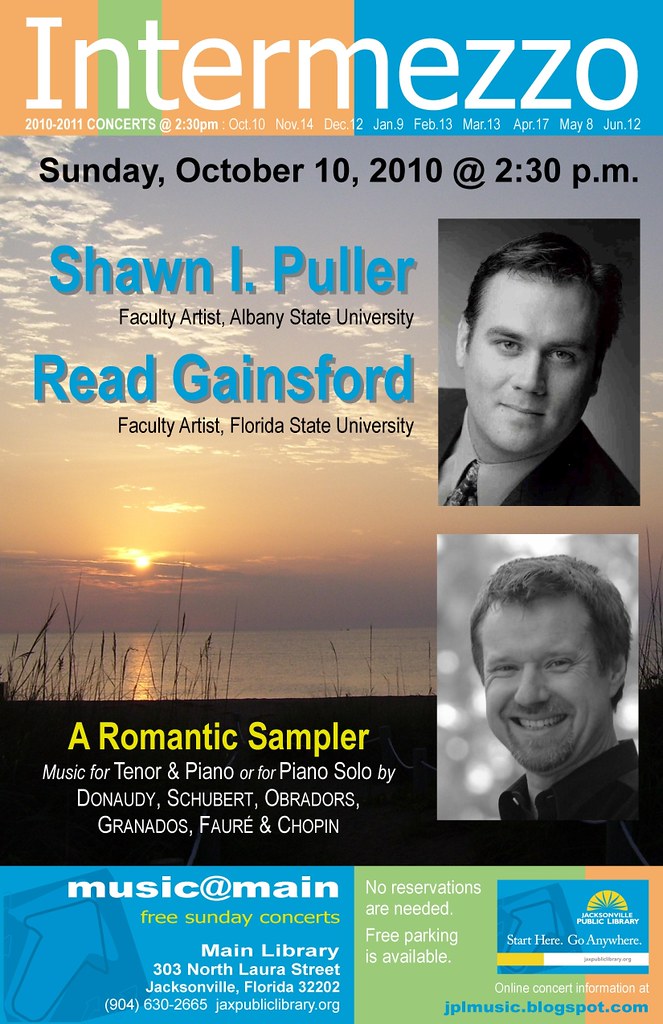
Intermezzo Sunday Concert, 10/10/2010 @ 2:30pm

A Romantic Sampler

oct10-flyer

Shawn I. Puller, tenor [Jacksonville Debut]
Read Gainsford, piano

Faculty artists from Albany State University and Florida State University team up for an afternoon of song and solo piano music!
PROGRAM SELECTIONS
  • Stefano Donaudy (1879-1925)
    Sento nel core -- Ah, mai non cessate -- Quando ti rivedrò -- O del mio amato ben
  • Franz Schubert (1798-1828)
    Impromptu in B-flat major, D. 935 No.3
  • Franz Schubert (1797-1828)
    Der Jüngling an der Quelle -- Der Jüngling am Bache -- Der Jüngling und der Tod
  • Fernando Obradors (1897-1945)
        Selections from Canciones clásicas españolas
    La mi sola, Laureola -- Del cabello más sutil -- Al amor
  • Enrique Granados (1867-1916)
    La Maja y el Ruiseñor
  • Gabriel Fauré (1845-1924)
    Lydia -- Içi-bas -- Adieu
  • Frédéric Chopin (1810-1849)
    Ballade No. 4 in F Minor, Op. 52
PROGRAM NOTES, by Ed Lein, Music Librarian

Tenor Shawn Puller (Ph.D) is an Assistant Professor of Music at Georgia's Albany State University, and has taught in New York at SUNY Cortland and Ithaca College, as well as at Florida State University, where he is on the faculty of their Summer Music Camps. As director of both bands and choruses his teaching experience includes instruction of children as well as young adults, and as a vocal soloist, in addition to art-song literature, his repertoire includes opera, oratorio, and other large-scale choral works. Shawn has directed the music programs of several churches, and also has served as the Assistant Director of the Heifetz International Music Institute, in Wolfeboro, New Hampshire. Among other professional organizations, Dr. Puller is an active member of the National Association of Teachers of Singing, and serves as the head Archivist of the Georgia Chapter of NATS. This recital marks his Jacksonville debut.

Pianist Read Gainsford (D.M.) has performed widely in the USA, Europe, Australia, South Africa, and his native New Zealand as solo recitalist, concerto soloist and chamber musician. He has made successful solo debuts at the Wigmore Hall and Carnegie Hall's Weill Recital Hall, and has performed in many other prestigious venues, including the Kennedy Center, Queen Elizabeth Hall, Barbican Centre, Fairfield Halls, Birmingham Town Hall and St.-Martin-in-the-Fields. Dr. Gainsford has recorded for the Amoris label, BBC Radio Three, Radio New Zealand's Concert Programme, and has broadcast on national television in New Zealand, the UK, and Yugoslavia. Since moving to the United States in 1992, Read has been a guest artist for the American Music Teachers Association, has appeared at the Gilmore Keyboard Festival and the Music Festival of the Hamptons, and spent several summers as a member of the collaborative pianist faculty at the Heifetz International Music Institute. He is a member of the contemporary music group Ensemble X, the Garth Newel Chamber Players, and as the pianist with FSU's Trio Solis he has performed here twice previously for our Music @ Main programs. Formerly on the faculty of Ithaca College where he received the college-wide Excellence in Teaching Award in 2004, Dr. Gainsford became Associate Professor of Piano at FSU in 2005.

Don't feel too badly if you don't recognize the name of Stefano Donaudy (1879-1925)--although the Sicilian-born composer rates a place in Baker's Biographical Dictionary of Musicians (2001), there is no entry for him in the 2nd edition of New Grove Dictionary (also 2001). As a precocious "tween" Donaudy wrote Folchetto (1892), the first of his six operas. He enjoyed early successes with both his songs and operas, and he also composed a few purely instrumental pieces, including a symphonic poem, Le Rêve de Polysende. But his luck ran out with his poorly-received final opera, La Fiamminga (Naples, 1922), and the disappointment at its failure (apparently coupled with declining health) caused him to abandon composing for his few remaining years. Despite the composer's relative obscurity, several of Donaudy's three dozen Arie di Stile Antico ("Arias in Antique Style") have been championed from the early recorded era to the present day by many the world's foremost singers, including the famous tenors Enrico Caruso, Beniamino Gigli, Luciano Pavarotti, Plácido Domingo, José Carreras, and Andrea Bocelli.

Click the titles for texts & translations:
Sento nel core (I feel in my heart)
(36 Arie di Stile Antico, no. 9, 1918)
    Text: Anonymous

Ah, mai non cessate dal vostro parlar (Ah, never cease thy speech )
    (36 Arie di Stile Antico, no. 7, 1918)
    Text: Alberto Donaudy (1880-1941)

Quando ti rivedrò? (When might I see thee once again?)
(36 Arie di Stile Antico, no. 22, 1918)
    Text: Alberto Donaudy (1880-1941)
O del mio amato ben perduto incanto! (O thou, my most belov’d enchantment, lost!)
(36 Arie di Stile Antico, no. 18, 1918)
    Text: Alberto Donaudy (1880-1941)

During his short lifetime the Austrian composer Franz Schubert (1797-1828) composed hundreds of works of astounding lyric beauty, including symphonies, chamber works, masses, solo piano music, and songs. Although his music was regularly performed in private concerts for Vienna’s musical elite, Schubert was never able to secure a publisher for the bulk of his masterworks, so he depended on his devoted circle of friends for maintaining his finances. After his death (probably from medicinal mercury poisoning), Schubert’s wish to be buried next to Ludwig van Beethoven (1770-1827) was honored.
In 1827, Schubert wrote two sets of Impromptus for solo piano, with four pieces in varying musical forms in each set. His Impromptu in B-flat major, D. 935, No.3, is from the second set, published posthumously as his Op. 142. The piece is a theme with variations on a tune derived from his incidental music to the play, Rosamunde (D. 797, 1823), and also used in his String Quartet, No. 13, D. 804 (1824).
Schubert, who composed over 600 songs, has remained unsurpassed in his ability to marry poetry with music, and his song-writing genius was touted by no less than Beethoven—although the two composers apparently never met, during his final illness Beethoven was given scores to some of Schubert’s songs, and the older master expressed his great admiration for the younger composer’s artistry.

Der Jüngling an der Quelle (The Youth at the Spring)
 (D.300, ca.1816?, published 1842)
    Text: Johann Gaudenz Freiherr von Salis-Seewis (1762-1834)
Der Jüngling am Bache (The Youth by the Brook)   
Text (1803): Friedrich von Schiller (1759-1805)

Der Jüngling und der Tod (The Youth and Death)
 (D. 545, 1817, pub.1872)    
Text: by Joseph von Spaun (1788-1865)

Fernando Obradors (1897-1945) was a self-taught Catalan composer, pianist and conductor. Although he wrote orchestral music as well as a considerable amount of music for the stage, he is best remembered for his four sets of Canciones clásicas españolas, collected and arranged between 1921-1941. Obradors' settings perfectly capture the essence of the folk-songs, and they remain among the most popular Spanish-language songs in the repertoire of classically-trained singers.

La mi sola, Laureola (My Only Laureola)
(Canciones clásicas españolas, no. 7)
    Text: Juan Ponce (b.ca.1480)
Del cabello más sutil (From That Finest Hair)
(Canciones clásicas españolas, no. 4)
    Text: Anonymous
Al Amor (To My Love)
(Canciones clásicas españolas, no. 1)
    Text: Cristobal de Castillejo (d. 1550)

Like Obradors, Enrique Granados (1867-1916) was born in the Spanish region of Catalonia, and Granados' music is so characteristically "Spanish" that he is regarded as one of his homeland's most representative composers. His Goyescas (1909-11), a suite of 6 pieces in 2 books and inspired by the paintings of Francesco Goya, ranks with Iberia, by Isaac Albéniz (1860-1909), as the finest piano works from Spain. The famous Quejas, ó la maja y el ruiseñor (“Lament, or, The Maiden and the Nightingale”), is an intricate nocturne with glittering, bird-like trills near its conclusion. Granados himself premiered Goyescas, so it is clear that he was a virtuoso performer as well as composer.

Gabriel Urbain Fauré (1845-1924) was a composer, organist, pianist and teacher, and he is widely regarded as the greatest master of the French art-song and the foremost French composer of his generation. Although Fauré greatly admired Wagner he remained relatively free of Wagner’s highly-colored influence, and instead led his own harmonic revolution by treating chords with added 7ths and 9ths as consonant and by introducing modal inflections into an essentially diatonic framework; in the process he successfully bridged the styles of Saint-Saëns (his teacher) and Ravel (his student). Fauré’s compositions are distinguished by perfectly crafted melodies floating over rich and radiant backgrounds, and among his best-known works is the hauntingly beautiful choral Requiem.

Lydia
(Op.4, no,2)
    Text: Leconte de Lisle (1818-1894)
Ici-bas! (Here Below)
(Op.8, no.3, 1874?)
    Text: R.-F. Sully-Prudhomme (1839-1907)
Adieu
(Op. 21, no.3, 1878)
    Text: Charles Jean Grandmougin (1850-1930)


The Polish-born pianist Frédéric Chopin (1810-1849) was the first composer to make full use of the expressive qualities and coloristic potential of the piano when it was a still-developing keyboard instrument, and he rightly has been called the "Poet of the Piano." Much of all piano music by subsequent composers shows his influence, and his revolutionary use of chromatic harmonies and unusual key relationships profoundly influenced composers of symphonic music and operas as well, such as Franz Liszt and Richard Wagner--thus Chopin's importance in the development of the "Romantic" style in general can not be overestimated. Among his many achievements, Chopin is credited with establishing the Ballade as an extended instrumental form, and all four of his solo piano works bearing this title are considered among the crowning achievements of the Romantic period. British pianist and composer John Ogdon (1937-1989) called the Ballade No. 4, Op.52, completed in 1842, ”the most exalted, intense and sublimely powerful of all Chopin’s compositions ... it contains the experience of a lifetime.”