Showing posts with label Schubert. Show all posts

Saturday, September 8, 2012

Promenade! Art Walk Concert, 11/07/2012 @ 7pm


Jacksonville University Vocal Students
Kimberly Beasley, coordinator


Jacksonville University is a comprehensive, private university with more than 70 respected academic programs that attract nearly 3,000 students from all over Florida, across the nation, and around the world. Working closely with a distinguished faculty of professional performing artists and researchers, students can focus and refine their skills while deepening an appreciation for the musical arts.

Music students at Jacksonville University may pursue a Bachelor of Arts (B.A.), Bachelor of Fine Arts (B.F.A.), Bachelor of Music (B.M.), Bachelor of Music Education (B.M.E.), or a Bachelor of Science (B.S.).


Leanna Brown – Junior, B.F.A. in Music Theatre
Gretchen am Spinnrade / Schubert

Jordyn Jones – Junior, B.F.A. in Music Theatre
O Primavera / Tirindelli

Alec Hadden – Junior, B.F.A. in Music Theatre
They all Laughed / Gershwin
Shouldn’t I be less in Love (I Love You, You’re Perfect, Now Change) / DiPietro and Roberts

Michelle Csapek – Junior, B.F.A. in Music Theatre
Amorosi miei giorni / Donaudy
A New Life (from Jekyll and Hyde) / Wildhorn and Bricusse

Michelle Mestas – Senior, B.F.A. in Music Theatre
Abendempfindung an Laura / Mozart
I Remember (Evening Primrose) / Sondheim

Tiffany Thomas – Senior, B.M. in Voice Performance
Rencontre (Poème d'un jour) / Faure
I Wonder What Became of Me (St. Louis Woman) / Arlen and Mercer

Jet Thomas – Senior, B.F.A. in Music Theatre
Meine Rose / Schumann
Fly, Fly Away (Catch Me if You Can) / Shaiman and Wittman

Elyn Wolfe – Senior, B.F.A. in Music Theatre
La Serenata / Paolo Tosti
Now That I’ve Seen Her (Miss Saigon) / Schönberg and Boublil

Raquel Lopez – Senior, B.F.A. in Music Theatre
Quando ti rivedrò / Donaudy
Trouble Man (Lost in the Stars) / Weill

Brittany Nickell – Senior, B.M. in Voice Performance
Porgi, Amor (Marriage of Figaro) / Mozart
Breit' über mein Haupt / Strauss


Kimberly Beasley, Assistant Professor of Voice, holds a Bachelor's degree in Music Theatre from the University of Colorado, a Master of Music from Valparaiso University and a Certificate of Vocal Performance from Northwestern University where she studied with Sunny Joy Langton and coached with Sherrill Milnes. Singing in all styles, she has performed with the Jacksonville Symphony Orchestra, the Northwest Festival Orchestra in Chicago, Southwest Michigan Symphony, Elmhurst Symphony, the Northwest Indiana Symphony, DuPage Opera Theatre, the New Philharmonic Orchestra, Light Opera Works, Music at Main, Friday Musicale, Jacksonville University Orchestra, and the Grant Park Symphony Chorus and the Lyric Opera of Chicago Chorus at venues such as the Times-Union Center in Jacksonville, the Star Plaza in Indiana, Chicago’s Millennium Park , and the Civic Opera House in Chicago. Roles include Solvieg, Micaëla, Dorine, Serpina, Rosina, Cinderella, Angelica, Josephine, and Ciao-ciao San in productions of Cavalleria Rusticana, Fidelio, Turandot, Peer Gynt, Into the Woods, Suor Angelica, Barber of Seville, Tartuffe, H.M.S. Pinafore, Carmen, and Madama Butterfly. She is an avid recitalist, both locally and in concerts and recitals from Chicago to Colorado. Kimberly also serves as a stage and music director for musicals and operas. She was the music director, to critical acclaim, of Last Five Years for OneTheatre in Chicago, and in 2011 she stage directed Little Women, the Musical for Jacksonville University, a production which won awards for Best Actor and Best Lighting Design from Broadway World.

INTRODUCING THE SINGERS


Hailing from Annapolis, Maryland, Leanna Brown is a Junior in the B.F.A. Music Theatre program at JU. She has appeared in five productions in the Swisher Theater, with favorite roles including "Nellie Forebush" in South Pacific, "Gianetta" in The Gondoliers, and "Miss Dorothy" in Thoroughly Modern Millie. She also enjoyed preparing the role of "Amy" as understudy for JU's production of Little Women. Leanna thanks her family and friends for their continuing support.

Jordyn Jones is a Junior B.F.A. Musical Theatre major studying with Kimberly Beasley, and a member of Alpha Psi Omega and Delta Delta Delta. She has appeared in recent JU stage productions, including The Gondoliers (as "Tessa"), and in the award-winning Little Women. Other favorite roles include "Mona" (Chicago), "Philia" (A Funny Thing Happened on the Way to the Forum), "Rusty" (Footloose), "Ruth" (Seven Brides for Seven Brothers), "Jo March" (Little Women), "Daisy Mae" (Li’l Abner), and "Cinderella" (Cinderella), as well as part of the "Ensemble" in The Apple Tree.


Alec Hadden is a Junior working toward a Bachelor of Fine Arts degree in JU's Music Theatre program. Currently studying with visiting professor Jay Ivey, Alec is a graduate of Jacksonville's Episcopal High School where he sang the lead in a production of Fiddler on the Roof ("Tevye"). He has appeared in a number of JU theatrical productions, including Der Vampyr ("Lord Ruthven"), Little Women ("Mr. Laurence"), and The Apple Tree ("King Arik").


From a young age Michelle Csapek has been immersed in the performing arts. In her native Bolivia she had the opportunity to study dance, theater and singing with with a number of notable teachers. In addition to singing with the Bolivian Choral Society, she was a guest artist for a variety of competitions and musical events ranging from cabarets to classical concerts, and her theatrical roles included "Sandy" in Grease, and "Belle" in Beauty and the Beast. Michelle has appeared in music videos and commercials, and her dance performances included ballet, jazz and modern dance styles. In the United States she attended the Florida School of the Arts (Palatka, Fla.), where she participated in numerous dance productions and earned an A.S. in Dance Entertainment. She is currently pursuing a B.F.A in Musical Theatre at JU, where she has appeared in Little Women and The Gondoliers.


Soprano Michelle Mestas is in her Senior year at Jacksonville University. She is from the studio of Kimberly Beasley, and is completing a B.F.A. in the Music Theatre program. She appeared in JU's production of Little Women, the Musical, and in addition to singing Michelle is a host of JU108's student radio program, Radio Misfits, as well as the engineer for the station.


Jacksonville University Senior Tiffany Thomas is a Voice Performance major, and is working with Kimberly Beasley toward a Bachelor of Music degree. Before moving to Jacksonville from North Carolina, the soprano attended Durham School of the Arts, where she was a member of the Spotlight Cabaret Singers and coached middle school students in singing and choreography. Among her stage performances, Tiffany sang the role of "Fiametta" in JU's production of Gilbert and Sullivan's The Gondoliers.


Originally from South Florida, Jet Thomas will be graduated this spring with a B.F.A. in Music Theatre, and will pursue a performance career after graduation. This summer she performed at ABET (Atlantic Beach Experimental Theatre) in After Ashley ("Julie"), and with Players by the Sea in both Reefer Madness ("Mary Lane") and an original musical, Another Sign ("Anne"). You may have seen her in JU's productions of The Apple Tree ("Eve"), Little Women ("Amy"), and most recently, Thoroughly Modern Millie ("Millie").


Under the guidance of Kimberly Beasley, Elyn Wolfe is pursuing a Bachelor of Fine Arts degree. Elyn moved to Jacksonville from Stony Brook, New York, and is now in her Senior year at Jacksonville University. She is pursuing her degree in Music Theatre at JU, where among other roles she sang "Beth" in Little Women, the Musical, garnering glowing reviews in the process.


Mezzo-Soprano Belter Raquel Lopez (Junior) is originally from The Bronx, New York, and is working towards a B.F.A. in Musical Theatre. She has been in a wide variety of shows, including I Love You, Your Perfect Now Change ("Clergywoman), Little Women ("Meg"), and The Gondoliers ("The Duchess"). Raquel recorded a demo in New York to showcase the Latina "flair" reflective of her Puerto Rican heritage, and after graduation her heart is set on Broadway. In addition to studying and performing, Raquel is an active member of several organizations including the International Student Association (ISA), SNATS (Student of the National Association of Teachers of Singing), and Alpha Psi Omega.

Soprano Brittany Nickell, originally from Ft. Lauderdale, is in her Senior year at JU and majoring in Vocal Performance under Professor Beasley's guidance. Her operatic roles have included "Emmy Perth" in Marschner's Der Vampyr, and "Vittoria" in Gilbert and Sullivan's The Gondoliers. She has been a featured soloist on tour with the JU Chamber Singers, as well as in JU's “Baroque Opera Scenes” workshop production. Brittany is an active member of Alpha Epsilon Phi sorority and Alpha Psi Omega Honors Fraternity, and is a founding member and the President of JU’s SNATS (Students of the National Association of Teachers of Singing) chapter. She does volunteer work as a music teacher to children in after school programs, and she plans to attend graduate school after completing her degree at JU.

PROGRAM NOTES, by Edward Lein, Music Librarian

In addition to numerous symphonies, chamber works, masses, and solo piano music, the Austrian composer Franz Schubert (1797-1828) composed over 600 songs in his short life, and he has remained unsurpassed in the ability to marry poetry with music. Even Beethoven, who apparently never met the younger composer, touted Schubert's genius when he was given some of Schubert's songs shortly before his death. Gretchen am Spinnrade ("Gretchen at the Spinning Wheel") was the first work that brought a 16-year-old Schubert to the attention of Viennese music-lovers, and it is still regarded as among the finest of all German Lieder. The text, drawn from Goethe's Faust (Part 1), relays the obsessive confusion, bordering on despair, of the still innocent Gretchen after she has become infatuated with Faust, but then is seemingly deserted by him. The motion of Schubert's piano part reflects not only the whirring of the spinning wheel, but also Gretchen's increasingly agitated emotional state.


Pier Adolfo Tirindelli (1858-1937) was an Italian composer, violinist, conductor and teacher. In 1883 he accepted the post of professor of violin at the Conservatory of Venice, and assumed directorship of that institution from 1893 to 1895. He then moved to the United States until 1922, as a professor of violin and conducting at the Cincinnati Conservatory. Returning to his homeland, he devoted the last period of his life to composing, producing songs and instrumental works in addition to three operas. Tirindelli's Neapolitan song O Primavera (O Springtime), originally published in 1911 during his American sojourn, was dedicated to the famous Italian tenor Enrico Caruso (1873-1921).


George Gershwin (1898-1937) wrote his first song in 1916 and his first Broadway musical in 1919, and he remained a fixture of the New York stage for 14 successive years. In 1924 he enjoyed success in applying jazz idioms to concert works, as with Rhapsody in Blue, and until the end of his life he produced larger-scale works alongside songs for musicals and films. They All Laughed is included in Shall We Dance?, the 1937 movie musical starring Fred Astaire and Ginger Rogers.

Although The Fantasticks maintains the number one spot, I Love You, You're Perfect, Now Change, by Joe DiPietro and Jimmy Roberts, is the second-longest running Off Broadway musical, amassing 5003 performances between 1996 and 2008. Described as "Seinfeld set to music," it is structured as a series of mostly independent vignettes with a multitude of different characters, but taken together the scenes depict a progression of romantic life from the first date through married life with children. In Shouldn’t I be less in Love an unnamed "Man" reflects on expectations one has after 30 years of married life.


Don't feel too badly if you don't recognize the name of Stefano Donaudy (1879-1925)--although the Sicilian-born composer rates a place in Baker's Biographical Dictionary of Musicians (2001), there is no entry for him in the 2nd edition of New Grove Dictionary (also 2001). As a precocious "tween" Donaudy wrote Folchetto (1892), the first of his six operas. He enjoyed early successes with both his songs and operas, and he also composed a few purely instrumental pieces. But his luck ran out with his poorly-received final opera, La Fiamminga (Naples, 1922), and the disappointment at its failure (apparently coupled with declining health) caused him to abandon composing for his few remaining years. Despite the composer's relative obscurity, several of Donaudy's three dozen 36 Arie di Stile Antico ("36 Arias in Antique Style," 1918, revised 1922) have been championed from the early recorded era to the present day by many the world's foremost singers. Amorosi miei giorni ("My Amorous Days"), the 27th song in the collection, is a setting of a poem by the composer's brother, Alberto Donaudy (1880-1941), who likewise provided the texts for the majority of Stefano's songs and operas.


Jekyll and Hyde (1990) is the best known musical by American composer Frank Wildhorn (b.1958), and at the same time it was on Broadway Wildhorn had two other shows playing just down the street: The Scarlett Pimpernel (1997) and The Civil War (1998), and these last two were nominated for Tony Awards, as was his Bonnie and Clyde (2009). Based on the Strange case of Dr. Jekyll and Mr. Hyde by Robert Louis Stevenson (1850-1894), the Tony-nominated book and lyrics of the musical version are by British composer Leslie Bricusse (b.1931), whose early collaborations with fellow Brit Anthony Newly (1931-1999) gained them international fame, along with both a 1963 Tony (for Stop the World, I Want to Get Off) and Grammy (for What Kind of Fool am I)--and Bricusse has since had numerous additional nominations for his work in movies and stage musicals, and has won two Oscars®. The song A New Life is sung by "Lucy," a showgirl infatuated with the kind-hearted Dr. Jekyll, who has just sent her money to move away to safety and start her life over. Sadly, she is also being terrorized by the murderous Mr. Hyde, who has other plans for her.


Austrian-born Wolfgang Amadeus Mozart (1756–1791), unquestionably one of the greatest composers in history, began his career touring Europe as a 6-year-old piano prodigy, and he absorbed and mastered all the contemporary musical trends he was exposed to along the way. Mozart wrote 22 operas, including, Le nozze di Figaro (1786), Don Giovanni (1787), Cosi fan tutte (1790), and The Magic Flute (1791), as well as 40 symphonies (“No. 37” is by Michael Haydn, but with a new introduction by Mozart), 27 concertos, chamber music, sonatas, and choral pieces, numbering over 600 works all together. Abendempfindung an Laura (Laura's Evening Sentiment" (K. 523) was written in 1787, and although exactly who "Laura" represents remains a mystery, her melancholy musing provided the inspiration for what is considered Mozart's finest song for voice and piano, which in turn provided Schubert a worthy example of what the genre might aspire to.

Described by The New York Times as the greatest artist working in musical theater, Stephen Sondheim (b.1930) certainly has won enough awards to help back up the statement, including eight Tony awards (more than any other individual), an Academy Award, multiple Grammys, and the Pulitzer Prize. His astounding output includes A Little Night Music, Into the Woods, Sunday in the Park with George, and Sweeney Todd, to name but a few. I Remember is one of four songs from the 1966 television musical Evening Primrose, and the hour-long production was written especially for a series called ABC Stage 67.


Gabriel Fauré (1845-1924) was a composer, organist, pianist and teacher, and he is widely regarded as the foremost French composer of his generation. Although Fauré greatly admired Wagner he remained relatively free of Wagner’s highly-colored influence, and instead led his own harmonic revolution by treating chords with added 7ths and 9ths as consonant and by introducing modal inflections into an essentially diatonic framework; in the process he successfully bridged the styles of Saint-Saëns (his teacher) and Ravel (his student). Fauré’s compositions are distinguished by perfectly crafted melodies floating over rich and radiant backgrounds. Among his best-known works is the hauntingly beautiful choral Requiem, and his songs and chamber music have as a devoted, and well-deserved, following. Rencontre ("Encounter") is the first of the three songs that comprise Fauré’s Poème d'un jour ("Poem of a Day"), Op. 21 (1880).

A preeminent composer of American popular song, Harold Arlen (1905-1986) began life as Hyman Arluk in Buffalo, New York, but changed his name in 1928, three years after he moved to The Big Apple to play piano for vaudeville acts. He scored his first big hit as a songwriter in 1929 with Get Happy, and didn’t stop until his catalog had over 400 entries and many standards, including Stormy Weather, That Old Black Magic, The Man That Got Away, and, of course, Over the Rainbow. I Wonder What Became of Me is from the 1946 musical St. Louis Woman, which Arlen co-wrote with Johnny Mercer (1909-1976). The show, based an the novel God Sends Sunday, by noted Harlem Renaissance writer Arna Bontemps 1902-1973), was criticized for the stereotypical portrayal of its characters, but the songs are regarded as among the very finest that the songwriting pair produced.

The hopes of the great German Romantic composer Robert Schumann (1810-1856) to become a concert pianist were dashed in his early twenties when he permanently damaged his hand, so he redirected his energies to both composing and music criticism. From childhood he was torn between literature and music, but he managed to combine these two loves even in some of his purely instrumental music by using poetry and dramatic narrative to color and direct the musical discourse. Although his taste in song texts sometimes seems questionable by today’s standards, Schumann’s keen literary sensibilities nonetheless made him one of history’s greatest songwriters, and his finest Lieder rival those of Schubert. Meine Rose ("My Own Rose") is the second song incuded in 6 Gedichte von N. Lenau und Requiem, Op.90 (1850). Schumann added the Requiem to the six poems by Lenau because, while composing the songs, Schumann was under the impression that the poet was deceased. He happily learned that Lenau was still alive, but by a strange turn of events, on the very day that the songs were first performed Schumann received word the Lenau had, in fact, just died.

Composer and arranger Marc Shaiman (b.1959) has won Tony, Grammy, and Emmy awards, has been nominated for the Oscar®, and has appeared in film, television, and theatrical productions as a performer. He is perhaps best known for the musical Hairspray (2002), which he co-wrote with lyricist, writer and director Scott Wittman (b.1959). Among numerous other collaborations, the partners have a new musical, Charlie and the Chocolate Factory: the Musical, in the works for a 2013 production date. In 2009 they wrote the songs for Catch Me If You Can, a musical based on the 2002 Steven Spielberg film, which in turn was based on the 1980 autobiography of Frank Abagnale, Jr., an elusive con artist. Fly, Fly Away is sung by "Brenda," a nurse who has fallen in love with the rogue and swears she will never help the FBI catch him--only she is tricked into doing just that.

In the earliest days of his career as a singer-songwriter, Italian composer Francesco Paolo Tosti (1846-1916) had a difficult time making a living, reportedly living on oranges and stale bread for weeks at a time. But his talents eventually lead him into the highest reaches of fashionable society, and he became singing master first to the Queen of Italy, and then, in 1880, to the British Royal family. By the mid-1880s he had become the most popular songwriter in Britain, and he received a professorship at the Royal Academy of Music in 1894. Tosti became a British citizen in 1906, and was knighted by King Edward VII in 1908, but he returned to his homeland in 1913 and spent his remaining years in Rome. Although he never wrote an opera, his finely crafted melodies have been favorites of opera stars since the early years of the recorded era.

Following the stunning success of their musical version of Les misérables (1985), composer Claude-Michel Schönberg (b.1944) and lyricist Alain Boublil (b.1941) scored another huge success with Miss Saigon (1989), in which they transform the story of Puccini's Madama Butterfly into a Vietnam War-era tragedy. Now That I’ve Seen Her is sung by "Ellen," the betrayed, but nonetheless determined, American wife of "Chris," the G.I. who fathered a child with the innocent Vietnamese girl, "Kim."

Stefano Donaudy's Quando ti rivedrò? ("When might I see thee once again?"), is the 22nd song in 36 Arie di Stile Antico, and like the aforementioned Amorosi miei giorni is a setting of a poem by the composer's brother, Alberto Donaudy.

German composer Kurt Weill (1900-1950) is most remembered for his works for the stage, especially The Threepenny Opera (1928), in collaboration with Bertolt Brecht (1898-1956), but he also produced a prodigious amount of art songs and concert and chamber music during the first decade of his career. Despite his popularity with the German public, Weill became a target of the Nazis during the early 1930s, and the Jewish socialist and his famous wife, the Austrian chanteuse and actress Lotte Lenya (1898-1981), were forced to flee Germany in 1933. They moved to New York City in 1935, and he eventually became an American citizen. Weill immersed himself in American popular song and Broadway musicals hoping to develop a style that synthesized European opera with American musical theater, perhaps building on Gershwin's Porgy and Bess (1935), but definitely setting the groundwork for future achievements, like Bernstein's West Side Story (1957) and Sondheim's Sweeney Todd (1979). Weill's efforts were officially rewarded in 1947 when Street Scene earned him the first-ever Tony Award for Best Original Score. Premiering in 1949, the year before his early death, Weill's last work for the stage was Lost in the Stars, with book and lyrics by Maxwell Anderson (1888-1959), and based on the novel Cry, the Beloved Country (1948) by Alan Paton (1903-1988). With South African apartheid as a backdrop, the sad, but ultimately hopeful tale relates the story of "Stephen Kumalo," a black Anglican priest, as he searches for his son, only finally to find him awaiting trail for murder. Before father and son are reunited, Father Stephen has a meeting with his son's pregnant girlfriend, "Irina," who relates her anxiety in Trouble Man.

In 1786, Mozart and librettist Lorenzo da Ponte (1749-1838) began their highly successful collaboration with the comic opera, Le nozze di Figaro (“The Marriage of Figaro”), which pokes wicked fun at the aristocracy. “Figaro,” formerly a barber in Seville, is now the valet to “Count Almaviva.” Figaro is about to marry “Susanna,” the maid to the Count's wife, and both Figaro and the "Countess" are unhappy, to say the least, when the Count makes inappropriate advances toward Susanna. Eventually the bride and groom team up with the wronged Countess to outwit the old philander, but not before the Countess laments her husband's would-be infidelity in Porgi, Amor ("Grant me, O Love").

Richard Strauss (1864-1949) was the most famous German composer of the late Romantic and early modern eras, and was also one of the period's most famous conductors. Among his best-known works are his operas, including Der Rosenkavalier and Salome; and his tone poems, including Death and Transfiguration, Till Eulenspiegel's Merry Pranks, and Also sprach Zarathustra, the opening of which is immediately identified with Stanley Kubrick's revolutionary film, 2001: A Space Odyssey. Strauss wrote songs throughout his career, including his very last work, the beautiful Vier letzte Lieder ("Four Last Songs", 1948), for soprano and orchestra. Published in 1923, Breit' über mein Haupt dein schwarzes Haar ("Upon My Head Let Fall Thy Black Hair") is the second song in Strauss's 6 Lieder aus 'Lotosblätter' ("6 Songs from 'Lotus Petals'"), Op. 19, on poems by Aldolf Friedrich Graf von Schack (1815-1894).


Monday, June 18, 2012

Promenade! Art Walk Concert, 04/03/2013 @ 7pm

Krzysztof Biernacki, baritone
Denise Wright, piano


Schubert: Die schöne Müllerin, Op. 25 (D.975)


Baritone Krzysztof Biernacki has established a strong reputation as a powerful performer, versatile stage director, and talented teacher. Born and raised in Poland, his professional credits include opera, oratorio, concert, and recital performances in Canada, the United States, and Europe. Dr. Biernacki has sung principal roles with Vancouver Opera, Manitoba Opera, Calgary Opera, Orchestra London Canada, Theater of Usti nad Labem (Czech Republic), as well as with opera ensembles of University of British Columbia and University of Western Ontario. Dr. Biernacki frequently performs song recitals with repertoire ranging from Haydn to Szymanowski, Shostakovich, and Britten, and his commitment to contemporary music is highlighted by world premiere performances heard on CBC Radio and CBC Saturday Afternoon at the Opera, including a highly acclaimed production of Filumena, co-produced by the Calgary Opera and Banff Centre for Performing Arts.  He made his Carnegie Hall debut with th UNF Wind Ensemble performing works of Tchaikovsky and Tosti, and was reengaged for a recital of opera arias and duets at Carnegie Zankel Hall. Summer engagements have included solo recitals in Italy and Poland, concerts with North Czech Philharmonic Orchestra, and stage directing engagements at the European Music Academy in the Czech Republic. Krzysztof Biernacki holds degrees from the University of Manitoba (B. Mus.), University of Western Ontario (M. Mus.), and University of British Columbia (D.M.A). He is the head of Applied Voice and Director of UNF Opera Ensemble at the University of North Florida in Jacksonville.

Jacksonville native Denise Wright received her Bachelor of Music degree in Piano Performance from Samford University (Birmingham, Alabama), and her Master of Music in Piano Performance from Indiana University (Blommington). As a young artist, Ms. Wright was active in a myriad of events sponsored by the Jacksonville Music Teachers Association. While at Samford, she served as a pianist for the Baptist Festival Singers European Tour. She was a Professor of Piano at Bethel College (Mishawaka, Indiana), and was a collaborative pianist at both Indiana University and at St. Mary’s College (Notre Dame, Indiana). Returning to Jacksonville in 1991, Ms. Wright assumed the position of pianist at First Baptist Church. Highly sought after as accompanist, she joined the staff of the University of North Florida where she works with several voice studios, as well as with the UNF Opera Ensemble. She also serves as accompanist at Douglas Anderson Shcool of the Arts, Jacksonville University, and for RC Arts Management. Ms. Wright balances her many artistic endeavors with raising her five children: Sarah, Victoria, Joshua, Anna, and Daniel.


In addition to numerous symphonies, chamber works, masses, and solo piano music, the Austrian composer Franz Schubert (1797-1828) composed over 600 songs in his short life, and he has remained unsurpassed in the ability to marry poetry with music. Even Beethoven, who apparently never met the younger composer, touted Schubert's genius when he was given some of Schubert's songs (including Die schöne Müllerin) shortly before his death. Although Schubert was virtually unknown to the general public, his music was regularly performed in private concerts for Vienna’s musical elite, and by 1825 he was in negotiations with four different publishers. But the bulk of Schubert's masterworks remained unpublished at the time of his death, so he generally had had to depend on his devoted circle of friends to help maintain his finances. After Schubert died, probably from medicinal mercury poisoning, his wish to be buried next to Beethoven, who had died just the previous year, was honored.

    Die schöne Müllerin
  1. Das Wandern ("To Wander")
  2. Wohin? ("To Whence?")
  3. Halt! ("Stop!")
  4. Danksagung an den Bach" ("Thanksgiving to the Brook")
  5. Am Feierabend ("At Quitting Time")
  6. Der Neugierige ("The Inquisitor")
  7. Ungeduld ("Impatience")
  8. Morgengruß ("Morning Greeting")
  9. Des Müllers Blumen ("The Miller's Flowers")
  10. Tränenregen ("Rainstorm of Tears")
  11. Mein! ("Mine!")
  12. Pause ("Intracte")
  13. Mit dem grünen Lautenbande ("With the Green Lute-ribbon")
  14. Der Jäger ("The Hunter")
  15. Eifersucht und Stolz ("Jealousy and Pride")
  16. Die liebe Farbe ("The Favorite Color")
  17. Die böse Farbe (The Wicked Color")
  18. Trockne Blumen ("Drying Flowers")
  19. Der Müller und der Bach ("The Miller and the Brook")
  20. Des Baches Wiegenlied ("The Brook's Lullaby")

Although Beethoven's lovely An die ferne Geliebte (To the Distant Beloved, 1816) is generally cited as being the first "song cycle," Schubert's Die schöne Müllerin (The Miller's Lovely Daughter, 1823-24) is the first song cycle of its own type. Beethoven's cycle is one continuous movement with several contrasting sections, along the lines of a sung fantasia, in which music from the beginning returns at the end so as to form a kind of musical circle. In contrast, Schubert composed a set of related songs intended to be performed as a group in a specified order, but each of the 20 songs is nonetheless self-contained, and so may also stand alone as a separate piece. Thus, Schubert's concept of the song cycle is more in keeping with a Baroque-era solo cantata, with piano accompaniment. And it is Schubert's model more than Beethoven's which has provided inspiration for song cycles by later composers, from Schumann and Mahler to Britten and Barber, and beyond


In truth, Schubert's groundbreaking work, first published in 1824, was really the concept of German poet Wilhelm Müller (1794-1827). In 1820, when Müller published his cycle of 25 poems about a young miller’s apprentice who finds but then loses love, he intended them as song lyrics, and later wrote a friend that he hoped "... a kindred spirit may some day be found, whose ear will catch the melodies from my words, and who will give me back my own" (Schubert Songs, by Maurice J.E. Brown). Although Schubert chose a number of Müller's poems as texts for other songs as well, including those of another great cycle, Winterreise (Winter Journey, 1828), there is no evidence that Müller ever knew that his "kindred spirit" indeed had been found, and that Schubert used his words to create unsurpassed musical masterpieces.

Die schöne Müllerin

Tuesday, September 21, 2010

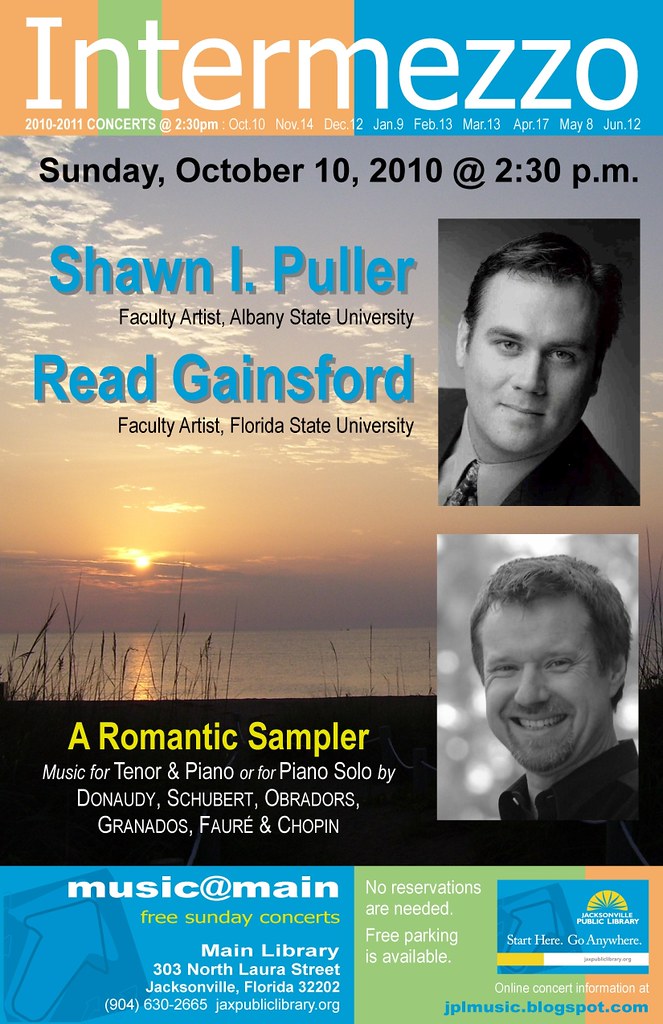
Intermezzo Sunday Concert, 10/10/2010 @ 2:30pm

A Romantic Sampler

oct10-flyer

Shawn I. Puller, tenor [Jacksonville Debut]
Read Gainsford, piano

Faculty artists from Albany State University and Florida State University team up for an afternoon of song and solo piano music!
PROGRAM SELECTIONS
  • Stefano Donaudy (1879-1925)
    Sento nel core -- Ah, mai non cessate -- Quando ti rivedrò -- O del mio amato ben
  • Franz Schubert (1798-1828)
    Impromptu in B-flat major, D. 935 No.3
  • Franz Schubert (1797-1828)
    Der Jüngling an der Quelle -- Der Jüngling am Bache -- Der Jüngling und der Tod
  • Fernando Obradors (1897-1945)
        Selections from Canciones clásicas españolas
    La mi sola, Laureola -- Del cabello más sutil -- Al amor
  • Enrique Granados (1867-1916)
    La Maja y el Ruiseñor
  • Gabriel Fauré (1845-1924)
    Lydia -- Içi-bas -- Adieu
  • Frédéric Chopin (1810-1849)
    Ballade No. 4 in F Minor, Op. 52
PROGRAM NOTES, by Ed Lein, Music Librarian

Tenor Shawn Puller (Ph.D) is an Assistant Professor of Music at Georgia's Albany State University, and has taught in New York at SUNY Cortland and Ithaca College, as well as at Florida State University, where he is on the faculty of their Summer Music Camps. As director of both bands and choruses his teaching experience includes instruction of children as well as young adults, and as a vocal soloist, in addition to art-song literature, his repertoire includes opera, oratorio, and other large-scale choral works. Shawn has directed the music programs of several churches, and also has served as the Assistant Director of the Heifetz International Music Institute, in Wolfeboro, New Hampshire. Among other professional organizations, Dr. Puller is an active member of the National Association of Teachers of Singing, and serves as the head Archivist of the Georgia Chapter of NATS. This recital marks his Jacksonville debut.

Pianist Read Gainsford (D.M.) has performed widely in the USA, Europe, Australia, South Africa, and his native New Zealand as solo recitalist, concerto soloist and chamber musician. He has made successful solo debuts at the Wigmore Hall and Carnegie Hall's Weill Recital Hall, and has performed in many other prestigious venues, including the Kennedy Center, Queen Elizabeth Hall, Barbican Centre, Fairfield Halls, Birmingham Town Hall and St.-Martin-in-the-Fields. Dr. Gainsford has recorded for the Amoris label, BBC Radio Three, Radio New Zealand's Concert Programme, and has broadcast on national television in New Zealand, the UK, and Yugoslavia. Since moving to the United States in 1992, Read has been a guest artist for the American Music Teachers Association, has appeared at the Gilmore Keyboard Festival and the Music Festival of the Hamptons, and spent several summers as a member of the collaborative pianist faculty at the Heifetz International Music Institute. He is a member of the contemporary music group Ensemble X, the Garth Newel Chamber Players, and as the pianist with FSU's Trio Solis he has performed here twice previously for our Music @ Main programs. Formerly on the faculty of Ithaca College where he received the college-wide Excellence in Teaching Award in 2004, Dr. Gainsford became Associate Professor of Piano at FSU in 2005.

Don't feel too badly if you don't recognize the name of Stefano Donaudy (1879-1925)--although the Sicilian-born composer rates a place in Baker's Biographical Dictionary of Musicians (2001), there is no entry for him in the 2nd edition of New Grove Dictionary (also 2001). As a precocious "tween" Donaudy wrote Folchetto (1892), the first of his six operas. He enjoyed early successes with both his songs and operas, and he also composed a few purely instrumental pieces, including a symphonic poem, Le Rêve de Polysende. But his luck ran out with his poorly-received final opera, La Fiamminga (Naples, 1922), and the disappointment at its failure (apparently coupled with declining health) caused him to abandon composing for his few remaining years. Despite the composer's relative obscurity, several of Donaudy's three dozen Arie di Stile Antico ("Arias in Antique Style") have been championed from the early recorded era to the present day by many the world's foremost singers, including the famous tenors Enrico Caruso, Beniamino Gigli, Luciano Pavarotti, Plácido Domingo, José Carreras, and Andrea Bocelli.

Click the titles for texts & translations:
Sento nel core (I feel in my heart)
(36 Arie di Stile Antico, no. 9, 1918)
    Text: Anonymous

Ah, mai non cessate dal vostro parlar (Ah, never cease thy speech )
    (36 Arie di Stile Antico, no. 7, 1918)
    Text: Alberto Donaudy (1880-1941)

Quando ti rivedrò? (When might I see thee once again?)
(36 Arie di Stile Antico, no. 22, 1918)
    Text: Alberto Donaudy (1880-1941)
O del mio amato ben perduto incanto! (O thou, my most belov’d enchantment, lost!)
(36 Arie di Stile Antico, no. 18, 1918)
    Text: Alberto Donaudy (1880-1941)

During his short lifetime the Austrian composer Franz Schubert (1797-1828) composed hundreds of works of astounding lyric beauty, including symphonies, chamber works, masses, solo piano music, and songs. Although his music was regularly performed in private concerts for Vienna’s musical elite, Schubert was never able to secure a publisher for the bulk of his masterworks, so he depended on his devoted circle of friends for maintaining his finances. After his death (probably from medicinal mercury poisoning), Schubert’s wish to be buried next to Ludwig van Beethoven (1770-1827) was honored.
In 1827, Schubert wrote two sets of Impromptus for solo piano, with four pieces in varying musical forms in each set. His Impromptu in B-flat major, D. 935, No.3, is from the second set, published posthumously as his Op. 142. The piece is a theme with variations on a tune derived from his incidental music to the play, Rosamunde (D. 797, 1823), and also used in his String Quartet, No. 13, D. 804 (1824).
Schubert, who composed over 600 songs, has remained unsurpassed in his ability to marry poetry with music, and his song-writing genius was touted by no less than Beethoven—although the two composers apparently never met, during his final illness Beethoven was given scores to some of Schubert’s songs, and the older master expressed his great admiration for the younger composer’s artistry.

Der Jüngling an der Quelle (The Youth at the Spring)
 (D.300, ca.1816?, published 1842)
    Text: Johann Gaudenz Freiherr von Salis-Seewis (1762-1834)
Der Jüngling am Bache (The Youth by the Brook)   
Text (1803): Friedrich von Schiller (1759-1805)

Der Jüngling und der Tod (The Youth and Death)
 (D. 545, 1817, pub.1872)    
Text: by Joseph von Spaun (1788-1865)

Fernando Obradors (1897-1945) was a self-taught Catalan composer, pianist and conductor. Although he wrote orchestral music as well as a considerable amount of music for the stage, he is best remembered for his four sets of Canciones clásicas españolas, collected and arranged between 1921-1941. Obradors' settings perfectly capture the essence of the folk-songs, and they remain among the most popular Spanish-language songs in the repertoire of classically-trained singers.

La mi sola, Laureola (My Only Laureola)
(Canciones clásicas españolas, no. 7)
    Text: Juan Ponce (b.ca.1480)
Del cabello más sutil (From That Finest Hair)
(Canciones clásicas españolas, no. 4)
    Text: Anonymous
Al Amor (To My Love)
(Canciones clásicas españolas, no. 1)
    Text: Cristobal de Castillejo (d. 1550)

Like Obradors, Enrique Granados (1867-1916) was born in the Spanish region of Catalonia, and Granados' music is so characteristically "Spanish" that he is regarded as one of his homeland's most representative composers. His Goyescas (1909-11), a suite of 6 pieces in 2 books and inspired by the paintings of Francesco Goya, ranks with Iberia, by Isaac Albéniz (1860-1909), as the finest piano works from Spain. The famous Quejas, ó la maja y el ruiseñor (“Lament, or, The Maiden and the Nightingale”), is an intricate nocturne with glittering, bird-like trills near its conclusion. Granados himself premiered Goyescas, so it is clear that he was a virtuoso performer as well as composer.

Gabriel Urbain Fauré (1845-1924) was a composer, organist, pianist and teacher, and he is widely regarded as the greatest master of the French art-song and the foremost French composer of his generation. Although Fauré greatly admired Wagner he remained relatively free of Wagner’s highly-colored influence, and instead led his own harmonic revolution by treating chords with added 7ths and 9ths as consonant and by introducing modal inflections into an essentially diatonic framework; in the process he successfully bridged the styles of Saint-Saëns (his teacher) and Ravel (his student). Fauré’s compositions are distinguished by perfectly crafted melodies floating over rich and radiant backgrounds, and among his best-known works is the hauntingly beautiful choral Requiem.

Lydia
(Op.4, no,2)
    Text: Leconte de Lisle (1818-1894)
Ici-bas! (Here Below)
(Op.8, no.3, 1874?)
    Text: R.-F. Sully-Prudhomme (1839-1907)
Adieu
(Op. 21, no.3, 1878)
    Text: Charles Jean Grandmougin (1850-1930)


The Polish-born pianist Frédéric Chopin (1810-1849) was the first composer to make full use of the expressive qualities and coloristic potential of the piano when it was a still-developing keyboard instrument, and he rightly has been called the "Poet of the Piano." Much of all piano music by subsequent composers shows his influence, and his revolutionary use of chromatic harmonies and unusual key relationships profoundly influenced composers of symphonic music and operas as well, such as Franz Liszt and Richard Wagner--thus Chopin's importance in the development of the "Romantic" style in general can not be overestimated. Among his many achievements, Chopin is credited with establishing the Ballade as an extended instrumental form, and all four of his solo piano works bearing this title are considered among the crowning achievements of the Romantic period. British pianist and composer John Ogdon (1937-1989) called the Ballade No. 4, Op.52, completed in 1842, ”the most exalted, intense and sublimely powerful of all Chopin’s compositions ... it contains the experience of a lifetime.”